So you want to train in martial arts with the masters of all masters? Learn the secrets that earned the greatest warriors of Japanese history their fame? Gain superhuman abilities such as making your body impervious to blades and arrows, fire and ice? Where do you go? TENGU DOJO!
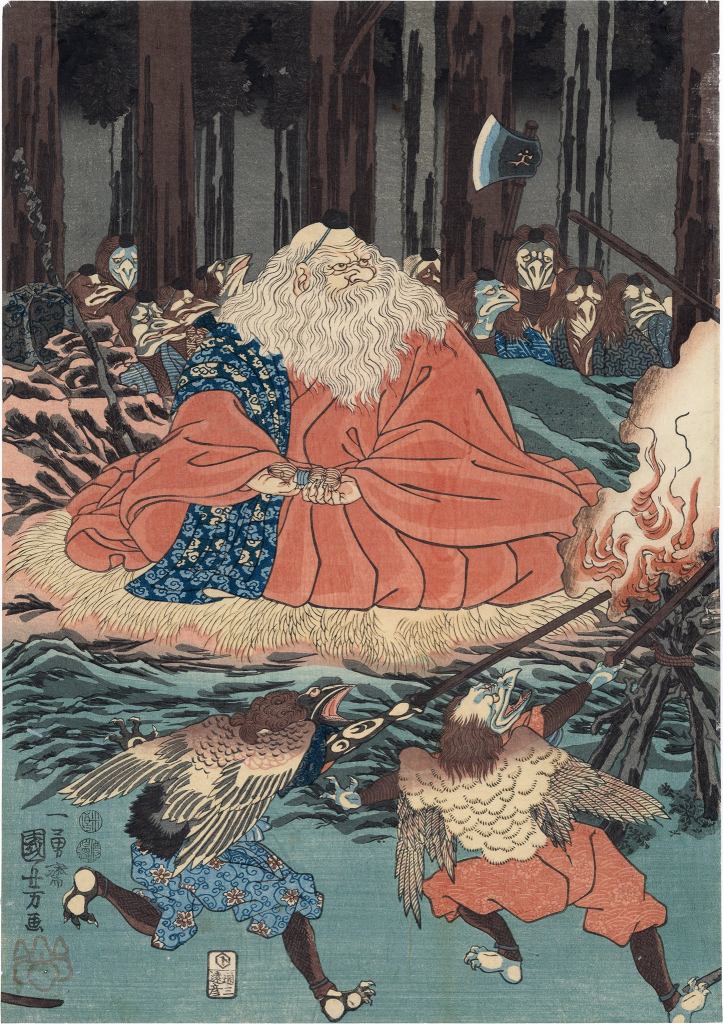
Tengu are immortal beings that appear as part human, part bird. They live on high mountains all over Japan. Some see them as demons, others as messengers of the gods, but everyone agrees that they are the undisputed masters of martial arts. They possess secrets beyond the knowledge of mortals – except those they deem worthy to teach.
If you feel you have what it takes to train with truly legendary instructors at Tengu Dojo, you will find the following RAQs (Rarely Asked Questions) indispensable.
Q: HOW CAN I FIND A TENGU DOJO NEAR ME?
First of all, beware of imitations. Any place that advertises itself as a “Tengu Dojo” is highly unlikely to be a licensed branch, and is probably not run by real tengu at all. The sign shown here, for example, appears in the Sagamiko Pleasure Forest amusement park in Kanagawa, but the arrow only points to an aerial ropes course. Anyone who comes expecting to receive instruction from genuine tengu will be disappointed.

To distinguish a legitimate branch from an imitation, look for the following signs:
- It will be located on top of a mountain.
- You will almost certainly NOT see any signs saying “Tengu Dojo.” You will, however, most likely see a temple or shrine.
- If you see a human-like figure dressed like a tengu, take a discreet look (carefully avoiding any appearance of staring) at its nose. If it appears to be normal size, you are not seeing a tengu but a yamabushi, an ordinary human who practices the religion of Shugendo. However, where yamabushi appear, tengu are never far away, so their presence is an encouraging sign that you’re approaching your goal.
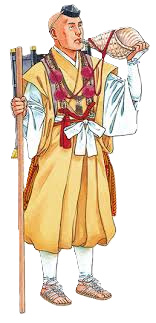
Some of the more famous branches include:
MT. KURAMA

- Location: Kyoto
- Chief Instructor: Sojo-bo
- Claim to Fame: The original Tengu Dojo. The chief instructor is known as the lord and master of all tengu, with strength equaling a thousand ordinary tengu (although Taro-bo, chief instructor of the Mt. Atago branch, might beg to differ). The most famous graduate is the twelfth-century warrior Minamoto no Yoshitsune, who began his training there at the age of 10, and used his knowledge to lead his clan to victory in the Genpei War. This branch is renowned not only for the martial arts, but also for the healing arts; Mikao Usui, the founder of Reiki, learned the technique of energy healing after a 21-day fast on Mt. Kurama. Be advised, however, that since this is the most famous among the Tengu Dojo, competition for admission is likely to be fierce, and your chances might be better at a smaller branch.
MT. IWAMA
- Location: Ibaraki Prefecture
- Chief Instructor: Undisclosed. One of the assistant instructors (the staff totaled 13 at last report) is known as Sugiyama Sojo, but this is believed to be a trade name.
- Claim to Fame: The most famous graduate is the boy known as Torakichi, who trained here for four years. His story, as told to the scholar Hirata Atsutane and published in 1822 as Senkyo Ibun (“Strange Tidings from the Realm of Immortals”), is one of only two known inside accounts of daily life and training at Tengu Dojo (click here for the other). Prospective applicants to this branch are advised that the entrance requirements include survival of a 100-day fast, a significant part of which might be spent with the applicant tied to a tree.
MT. AKIHA

- Location: Shizuoka Prefecture
- Chief Instructor: Sanshaku-bo
- Claim to Fame: The only known branch whose chief instructor was once human. He first came to Mt. Akiha at the tender age of four. After more than twenty years, his ascetic training culminated in a 21-day ritual that resulted in his being granted the shape of a tengu. Some applicants have been drawn to this branch in the belief that the instructor, remembering his human life, might have a more realistic idea of the limits of human endurance than others. However, since he has been in his tengu form for over 1200 years, this may not be a safe assumption.
MT. CHOKAI
- Location: Between Akita and Yamagata Prefectures
- Chief Instructor: Saburo-bo
- Claim to Fame: This is a lesser-known branch, but according to one legend, the ninth-century samurai Sakanoue no Tamuramaro learned his swordsmanship here. He then applied his skills to defeat Otakemaru, one of the most fearsome oni ever to terrorize Japan.
MT. HIKO

- Location: Between Fukuoka and Oita Prefectures, Kyushu
- Chief Instructor: Buzen-bo
- Claim to Fame: The most famous graduate is the sixteenth-century warrior Kobayakawa Takakage, a powerful ally to Toyotomi Hideyoshi in his struggle against Tokugawa Ieyasu to become Shogun of all Japan. Applicants from overseas should also note that this is also the only branch known to have accepted a foreign candidate for training, Simon Grey.
Q: HOW CAN I CONTACT MY CHOSEN BRANCH?
Tengu Dojo has no website, no listed telephone number, and may even be among the few places in Japan without a fax machine. Your best bet is to apply in person. Climb the mountain where your branch is located, and once you have reached the temple or shrine at the summit, recite the following incantation until an instructor appears: On-hira-hira-ken, hira-ken-nou-sowaka. For best results, this chant should be performed before an altar on which are arranged a bow and arrow, a sword, and a gohei (a wooden wand attached to a strip of white paper) with the name of your prospective instructor.
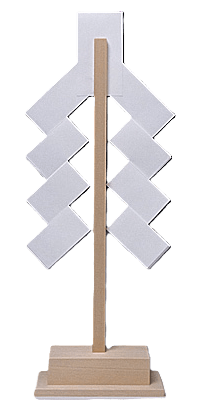
Q: HOW LONG WILL IT TAKE FOR MY APPLICATION TO BE PROCESSED?
Allow plenty of time. 21 days of continual supplication is the norm for any supernatural being in Japan. Some have been known to have their application period shortened under emergency circumstances (Simon Grey among them), but be aware that expedited processing may entail certain additional requirements such as meditating under freezing waterfalls, walking barefoot on hot coals, climbing ladders made of swords, and confessing your sins while suspended upside-down from a high precipice.
If you make it to the interview stage, remember: Flattery will get you everywhere. Tengu are notoriously proud and conceited, so appealing to your prospective instructor’s ego, and comparing him favorably to other tengu, will surely increase your chances of acceptance.
Q: WHAT WILL I LEARN?
Exact details of training in Tengu Dojo are a closely guarded secret, with only the occasional snippet ever revealed to the uninitiated. However, the curriculum is known to include both unarmed combat and weapons such as the long sword, short sword, bow, spear, staff, and naginata. Some branches have also been said to offer instruction in marksmanship, although it is unclear to what extent Tengu Dojo falls under the jurisdiction of the Firearms and Swords Control Law.
For trainees who have completed the basic course, advanced subjects are rumored to include Extreme Temperature Endurance, Resistance to Weaponry, Manipulation of Fire, Invisibility, and Animal Transformation.

Q: HOW’S THE FOOD IN TENGU DOJO?
The good news is that the food is generally vegetarian- and vegan-friendly. Although fish and game birds are sometimes served, the offerings usually consist of dishes such as wild potato wrapped in seaweed and fried in oil, or pine needles and bamboo leaves steeped in soy sauce. You may have heard rumors that tengu eat monkeys, but at least one Tengu Dojo graduate has reported that monkeys are not only off the menu but regarded as sacred.
The bad news, as you may have gathered, is that the menu was apparently not designed with the human body in mind, in terms of either taste, digestibility, or the calorie count necessary to sustain trainees through the grueling daily regimen. On the bright side, Tengu Dojo offers unparalleled opportunities for quick weight loss.
Q: WHAT SHOULD I PACK?
If you feel that the rations described above are not likely to be satisfactory, you should pack plenty of protein bars or other dietary supplements of your choice. Also, it’s highly recommended that you bring candied coffee beans, extra-sharp mints, or anything to keep you alert at night after an extremely demanding day. Tengu Dojo instructors are notorious for staying up late giving long, rambling lectures about military history, medicine, astronomy, or anything that captures their interest, whether related to your training or not. And of course, it is most inadvisable to risk offending your instructor by nodding off.
Q: WHERE CAN I FIND OUT MORE?
Most of the information we have on Tengu Dojo comes from Roald Knutsen’s Tengu (Global Oriental, 2011) and Carmen Blacker’s summary of the work of Hirata Atsutane (Collected Writings of Carmen Blacker, Routledge, 2016).
And for a firsthand account from the only known trainee from outside Japan, pick up a copy of Simon Grey and the Curse of the Dragon God.
 Simon Grey