In Utagawa Kuniyoshi’s famous painting, “Takiyasha the Witch and the Skeleton Spectre,” the viewer’s eyes are naturally drawn to the gashadokuro, the giant skeleton. But who is the figure on the left, pulling its strings?
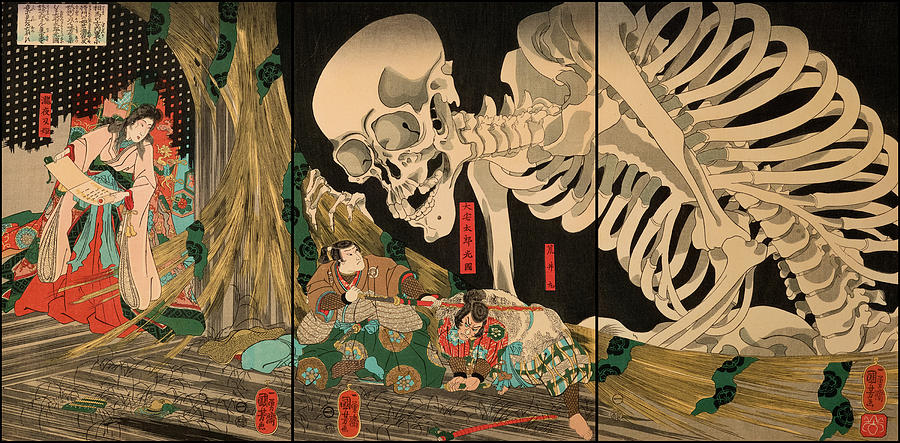
The legendary Takiyasha-hime (literally “Waterfall Demon Princess”) was the daughter of the historical Taira no Masakado (d. 940). Masakado led a rebellion against the Imperial court in Kyoto, and when it failed, all his family were declared traitors and ordered executed. His daughter somehow escaped, gained supernatural powers, and led an army of yokai to avenge her father’s death. Her story has been immortalized in books, kagura plays, ukiyo-e paintings, and recently, even computer games. And of course, she appears as a character in Simon Grey and the Curse of the Dragon God.
CK: I’m here tonight with the ghost of Takiyasha-hime. It’s a pleasure to meet you, Princess. Thank you for granting this interview.
TH: The pleasure is mine. A thousand years is a long time, and there aren’t as many people wanting to see me these days as there once were. Eternity can get a little lonely.
CK: First of all…may I call you Takiyasha-hime?
TH: Of course. That’s my name, after all.
CK: Just asking. After all, your birth name was Satsuki-hime. And one version of the story says that after you were defeated, you went back to your old name, and ultimately either joined your father in heaven or became a Bodhisattva, choosing to remain in this world until all of humanity was enlightened.
TH: Well, as you can see, I’m still here. And humanity certainly doesn’t seem to be any closer to enlightenment now than it was in my time. If I’m a Bodhisattva, I can’t be a very effective one, now can I?
CK: Your father led the first known uprising against the Imperial court in Kyoto. He tried to establish his own “Eastern Court” in your hometown of Shimo-Osa, which is now part of Ibaraki Prefecture. What made him decide to start a rebellion?
TH: I was only a little girl when my father was killed. I never had the chance to ask him in person, and afterwards, I heard conflicting stories about the inciting incident. Some say it was over a post at court, some say it was over an arranged marriage – usually something rather trivial. But one thing I know is that my father never had much time for the monarchy. The Emperor and his court did nothing but idle around in extravagant luxury while the common people scrimped and scratched for their daily ration of rice. And everything I’ve seen since then has only made me agree with him more strongly. What has the monarchy ever done for us, other than shut itself up in its palaces, arranging flowers and reciting poetry, while civil war tore the country apart?
CK: After your father’s attempted rebellion, everyone in his family was declared a traitor. How did you manage to escape the purge?
TH: I fled to Saifukuji, a temple near Mt. Tsukuba. They took me in as a Buddhist nun. There, I could live in safety and anonymity.
CK: They say that, during your novitiate, you often went off to climb Mt. Tsukuba. Like… (sings to the tune of “The Sound of Music”) “I go to the hills when I thirst for vengeance…”
TH: (gives blank look)
CK: Ahem…well, anyway, some versions of the story say you met a wizard there named Nikushisen, who sometimes appeared in the shape of a giant toad, and he taught you the magical arts. Others say you went to Kifune Shrine in Kyoto and performed the Ushi no Koku Mairi, the Visitation of the Hour of the Ox, praying to the vengeful god enshrined there at two o’clock every morning for twenty-one days. Which was it? How did you acquire your magical powers?
TH: Those who say I went to Kifune Shrine are probably confusing me with another vengeful princess, Hashi-hime, the Bridge Princess of Uji. I can’t really blame them, since Kifune Shrine is a popular spot for women who want supernatural powers to use against the men who wronged them. But if you think about it, Kyoto is a long way from Shimo-Osa, and for me, it was enemy country. And in any case, I would prefer something a little more original.

CK: Once you gained your powers, it’s said you used them to summon an army of yokai, to fight alongside your father’s remaining mortal followers in a second assault on the Imperial court.
TH: Yes. And we didn’t quite succeed…but boy, did we ever give them the scare of their lives!
CK: Afterwards, you went back to your father’s old home of Soma Castle. And the Emperor sent his best warrior, Oyataro no Mitsukuni, after you?
TH: That’s right. Along with his lieutenant, Yamashiro no Mitsunari, and a small army of Imperial soldiers.
CK: The story goes, while Mitsukuni and his army were resting up in a nearby town the night before the assault, you approached him in disguise and tried to seduce him?
TH: Ugh, don’t remind me. Pretending to make advances to that insufferable…well, let’s just say that was the biggest test I’ve ever faced of my skills as an actress. And it didn’t even work. After a few drinks, I thought he was starting to let his guard down. But he must have suspected me. He started boasting, in extremely graphic detail – I’ll spare you – about my father’s death. I couldn’t keep up the pretense, so I ran back to my castle and prepared my legions to repel his assault.

CK: But even with the help of all your allies, from both sides of the grave…
TH: To give Mitsukuni his due, he was both a samurai and an onmyoji. He was that extremely rare – possibly unique – person skilled in both the military arts and magic. In other words, he was what I believe you would call multiclassed. And I was what I believe you would call outclassed.
CK: Among your legions, it’s said you had an army of skeletons. But Utagawa Kuniyoshi’s famous painting of the final battle between you and Mitsukuni shows one giant skeleton.
TH: Ah, yes. The gashadokuro. A yokai that appears on battlefields, or any place where a great number of people died tragic deaths. All their bones fuse together to make one giant skeleton.
CK: So, which was it really?
TH: Let’s just say I like Kuniyoshi’s version.
CK: May I say, having seen you in the flesh – well, in the spirit – I don’t think he really did you justice.
TH: You flatter me.
CK: Are you blushing? I never knew ghosts did that.
TH: Are you flirting with a woman a thousand years older than you? I never knew mortal men did that.

CK: Recently, there’s been a resurgence of interest in you. You’re featured in the computer games Onmyoji and Icchibanketsu…
TH: And you were kind enough to put me in your book. Very nicely done, by the way.
CK: Thank you.
TH: Now who’s blushing?
CK: What would you say to people who want to pay their respects to you or your father?
TH: The temple where I trained is no longer standing, but there’s another one nearby, Tofukuji, that has a memorial to me. You have to look carefully – it’s in the middle of a field, and it’s just a little collection of stones and stakes. My father’s memorial is much easier to find. They built a shrine to appease his vengeful ghost, right in the shadow of Edo Castle – what’s now the Imperial Palace in Tokyo. Ironic, isn’t it? A thousand years ago, the Imperial court executed him as a rebel. Now they revere him as a god.

CK: Takiyasha-hime, thank you very much for your time tonight.
TH: My pleasure. And I hope your book does very well. You can tell people that if they don’t support you, I’ll send the gashadokuro after them!
 Simon Grey